
Why the Jamestown Frontier Society exists
Why I started the Jamestown Frontier Society and why the fastest change in human history is better met in good company.
Earlier this year, Demis Hassabis, Nobel laureate and CEO of Google DeepMind, described the coming of artificial general intelligence this way:
The coming of AGI is like 10 times the Industrial Revolution at 10 times the speed, unfolding over a decade instead of a century.
He said it during an interview with 20VC, and I have been thinking about the comparison ever since.
I do not know whether the number will hold up. Nobody can measure a revolution before it happens. I do believe the rate of technological change will be unlike anything we have experienced before, and it will be difficult for any one person to understand it alone.
Community is a scarcity
Most conversations about artificial intelligence focus on what the technology will make abundant: software, research, media, analysis, and eventually more work in the physical world through robotics. I keep coming back to something that already feels scarce: community.
We have endless information and fewer places where people can think out loud, disagree, and keep talking after the meeting ends. You can follow every product release, read every research paper, and still have nobody nearby to test an idea with over a beer or coffee.
That becomes a larger problem as the pace picks up. Artificial intelligence, agents, robotics, Bitcoin, and the energy systems behind them are developing across fields that no single person can follow well. A useful community lets people bring different parts of the map and compare what they are seeing.
It also makes the experience more fun. I would rather discuss a strange new agent, a robotics breakthrough, or a question about Bitcoin with interested people around a table than process it alone through another feed.
Why Jamestown
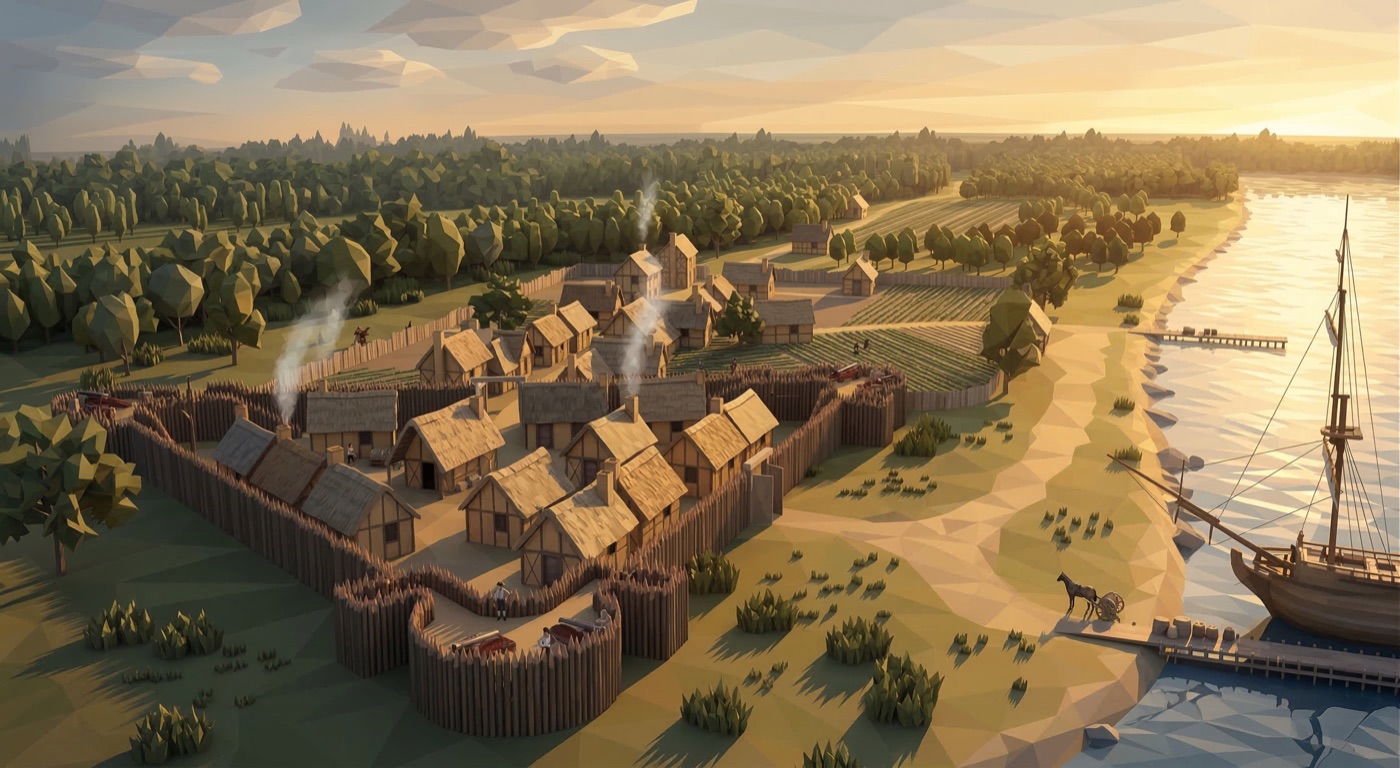
The Society is based near Jamestown, Virginia, where 104 English men and boys arrived in 1607 to establish the first permanent English settlement in North America.
Jamestown began as an effort to build in unfamiliar conditions. The settlers arrived with instructions from the Virginia Company, incomplete maps, and assumptions they had to revise as they learned the place. What began as a small settlement would help set political, economic, and cultural changes in motion far beyond the banks of the James River.
That history gives this group its sense of place. We are talking about a possible technological revolution near a site that helped set an earlier period of enormous change in motion. History and futurism sit beside each other here in a way that would be difficult to reproduce somewhere else.
The setting adds some reverence to the conversation. It is harder to treat a technological revolution like entertainment when you are meeting near a place where earlier decisions reshaped a continent. Questions about what people build, what they misunderstand, and what survives them carry more weight there.
What the Society does
The first version is intentionally simple. We come together over coffee or a beer and discuss what is changing, what we are building, and what we are reading. Someone may bring a tool they have been testing, an article they cannot stop thinking about, or an idea that needs other people to challenge it.
You do not need to be an expert or arrive with a presentation. The Society is for people who are curious enough to follow these changes and generous enough to share what they are learning. I want people to leave with a better understanding of the subject and a few relationships they can continue building outside the meeting.
Over time, I would like the Society to host lectures, panels, and workshops. Those formats can grow naturally from the interests and experience of the people who show up. The community comes first because the events will only be as useful as the people around them.
Camaraderie in the storm
I do not know whether Hassabis is right about the scale or the timeline. I find the pace exciting. Change this fast will create opportunities to build and explore things that were not possible before, and following it closely gives us a better chance to see those opportunities while they are still taking shape.
We are likely to see remarkable tools, bad assumptions, useful experiments, and consequences we did not anticipate. Having thoughtful people nearby should help us notice more, challenge our assumptions, and turn some of what we learn into projects of our own.
The Jamestown Frontier Society exists to build that community in a place where history already carries some weight. Join us in person when you can, or follow from farther away and compare notes with us. The next decade should give us plenty to talk about.